 By Azeez Ope Quadri
No. Annual returns filing and tax filing are not the same. The Corporate Affairs Commission (CAC) collects annual returns, while the Nigerian Revenue Service (NRS), formerly the Federal Inland Revenue Service (FIRS), collects taxes.
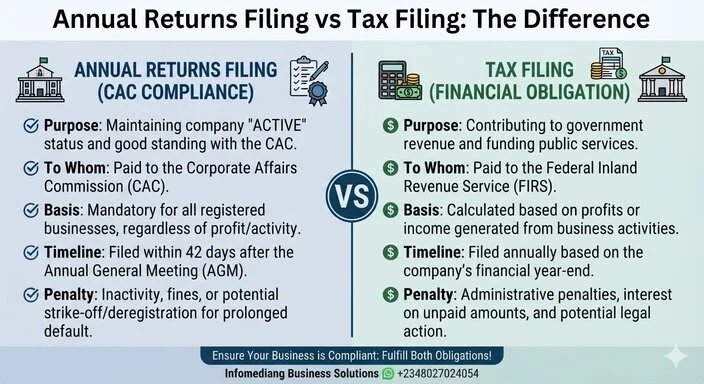
What the law says about annual return filing
Section 370 of the Companies and Allied Matters Act (CAMA) 2020 stipulates that a company or business must file annual returns with the CAC within 42 days after its Annual General Meeting (AGM). Failure to comply attracts penalties.
This means that the fact that you’ve filed your annual returns doesn’t stop you from paying your tax to the revenue service. They are two different obligations you must fulfil to keep your company in good standing and enjoy the benefits of compliance.
Major differences between Annual Returns and Tax Filing
Institutional difference
Annual returns are paid to the CAC, while tax is collected by the revenue service. Although both the CAC and the revenue service are government agencies, they fall under two different ministries.
The CAC is an agency under the Federal Ministry of Industry, Trade and Investment, while the revenue service is an agency under the Federal Ministry of Finance.
Obligational difference
Annual return filing is required whether the business engaged in transactional activities or not. Provided a business is registered with the CAC, it is expected to file returns every year. Tax filing, on the other hand, is done on profit made from business activities. Therefore, a business owner only starts to pay income tax the moment the business begins to make a profit.
Penalties
A business or company status will become “Inactive” the moment it fails to file annual returns for a certain number of years. Also, the business will be struck off or deregistered if the company defaults for a continuous number of years. There is a penalty for late filing of annual returns.
In the case where a company is in business but fails to file its taxes, different penalties apply depending on the specific tax type. For instance, there is a 10% administrative penalty per annum on the unpaid amount, plus interest at the prevailing CBN monetary policy rate, according to the tax laws.
Who must file annual returns?
- Registered companies
- Registered business names
- Churches
- Mosques
- NGOs
- Associations
- Clubs
- Cultural organisations, etc.
How to file annual returns to the CAC
Filing of annual returns to the CAC is done online. You can do this by following these steps:
- Log in to the CAC portal.
- Update your company details by providing your turnover and net assets.
- Attach an audited account if requested.
- Choose your financial year.
- Make payment and submit.
NOTE: You must consistently file annual returns to avoid yearly penalties. Only registered CAC agents can complete post-incorporation activities at the time of this publication.
Benefits of Filing Annual Returns in Nigeria
Guards against bulky penalty fees
The base cost of filing annual returns is affordable for both Business Names (BN) and Limited companies. However, the penalty fees for late filing accumulate quickly. Imagine you failed to file your company’s annual returns for 10 years; you’d be paying significantly more in penalties than the actual filing fees.
Prevents removal from the CAC database
In some cases, the CAC may strike off a Business Name or Limited Company that has defaulted on annual filing for a prolonged period. While this is redeemable by paying the outstanding fees, it can damage your business reputation, and it takes time to make your business name visible and active again on the CAC portal.
If a potential partner, whether local or international, checks your compliance status on the CAC Search Portal and sees you’re a defaulter, it could hurt your chances of closing a deal. Regular filing ensures compliance and minimizes this risk.
It protects your corporate image
Stakeholders and potential partners don’t take defaulters seriously. When they check your business record on CAC public search and find it marked as “INACTIVE” or “STRUCK OUT,” it creates a negative impression. It signals that you or your company may not be serious or trustworthy.
You might ask: Why do people check your CAC status? It’s a standard part of their due diligence before signing any deal with you.
Smooth business transition
There are cases where a Business Name owner wants to upgrade to a Limited Company. Such a transition cannot proceed smoothly if annual returns are not up to date for the BN; all outstanding returns must be cleared first.
The same applies to Limited companies wanting to change directors, update share capital, or restructure into a group of companies. Up-to-date filings are a prerequisite for such corporate changes.
Access to Government Tenders
Many government contracts and tenders require proof of compliance with statutory obligations, including annual returns. Timely filing enables your business to participate in government procurement processes and expand your market opportunities.
Access to credit facilities and grants
Another benefit of filing annual returns is that it boosts your business’s credibility. For instance, if a financial institution is reviewing loan applications and sees that one applicant is “STRUCK OUT” while another is “ACTIVE” on the CAC portal, it will assume the former is no longer in operation. Regular filing improves your chances of loan approval.
Above all, annual filing keeps your company “ACTIVE” on the CAC register. Failure to file can mark your company as “INACTIVE” or even lead to deregistration after a prolonged default.
Takeaways
Annual returns are not the same as tax, but both are mandatory compliance metrics that protect your business from penalties. While the CAC handles annual returns, tax filing is associated with the revenue service.
Are you finding it difficult to file your annual returns?
Get in touch with INFOMEDIANG BUSINESS SOLUTIONS on WhatsApp at +2348027024054 for the perfect solution.
 INFOMEDIANG SOLUTIONS