 By Azeez Ope Quadri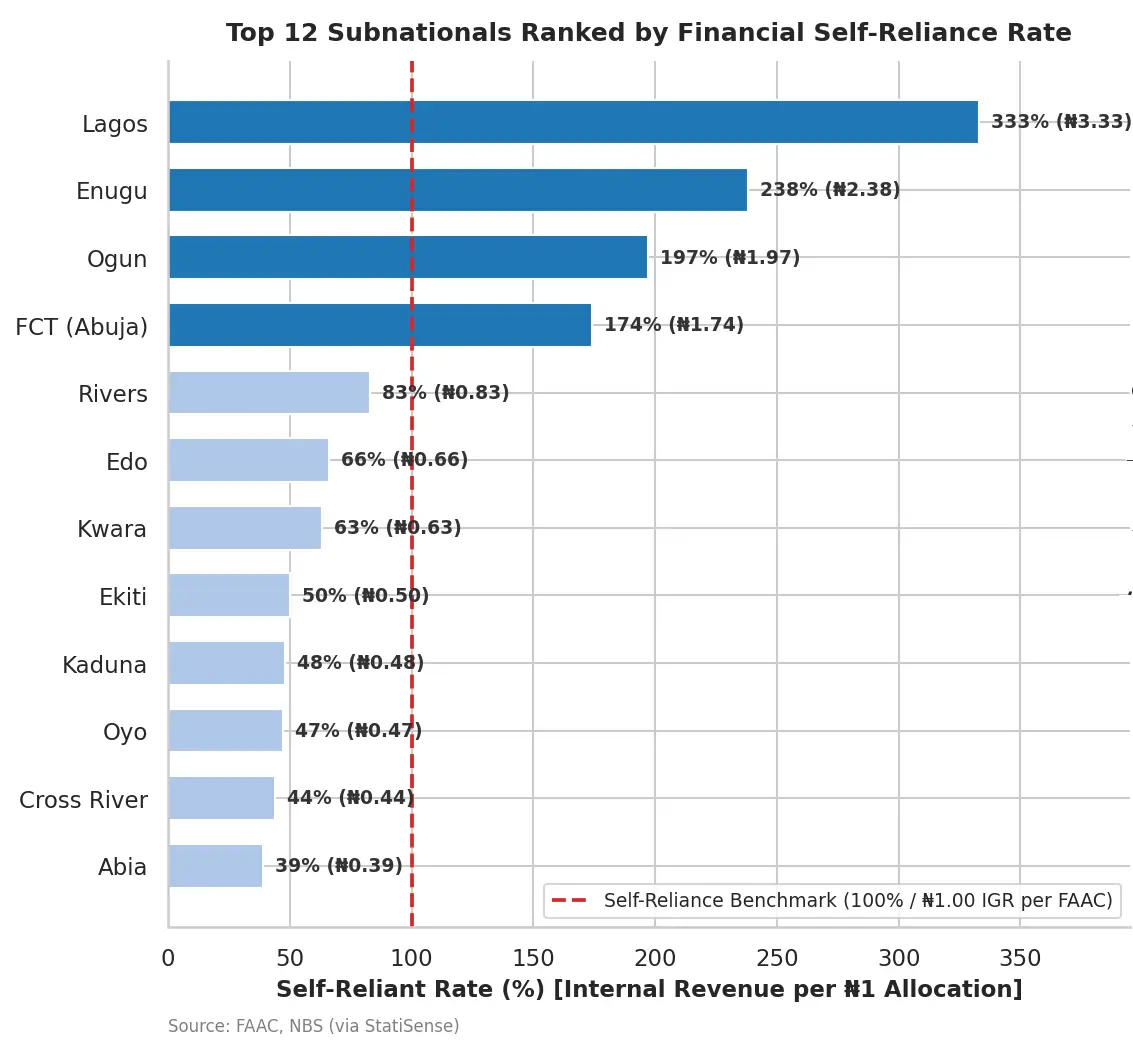
Data from the Federal Account Allocation Committee (FAAC) and National Bureau of Statistics (NBS) revealed that only 12 Nigerian states are financially self-reliant in 2025.
Lagos is the most financially self-reliant state for generating ₦3.33 in IGR for every ₦1 received from net FAAC, followed by Enugu and Ogun states respectively. Enugu generated ₦2.38 in IGR for every ₦1 received from net FAAC, while Ogun generated ₦1.97 in IGR for every ₦1 received from net FAAC.
The official benchmark formula is expressed as:
Self-Reliance Rate (%) = (Internally Generated Revenue ÷ Net FAAC Allocation) × 100
By this formula, it means Lagos has a 333% self-reliance rate; Enugu has a 238% self-reliance rate, while Ogun has a 197% self-reliance rate in 2025.
What did the states generate in IGR for every N1 net FAAC?
- Lagos generated ₦3.33 in IGR for every ₦1 received from net FAAC
- Enugu generated ₦2.38 in IGR for every ₦1 received from net FAAC.
- Ogun generated ₦1.97 in IGR for every ₦1 received from net FAAC.
- FCT generated ₦1.74 in IGR for every ₦1 received from net FAAC.
- Rivers generated ₦0.83 in IGR for every ₦1 received from net FAAC.
- Edo generated ₦0.66 in IGR for every ₦1 received from net FAAC.
- Kwara generated ₦0.63 in IGR for every ₦1 received from net FAAC.
- Ekiti generated ₦0.50 in IGR for every ₦1 received from net FAAC.
- Kaduna generated ₦0.48 in IGR for every ₦1 received from net FAAC.
- Oyo generated ₦0.47 in IGR for every ₦1 received from net FAAC.
- Cross River generated ₦0.44 in IGR for every ₦1 received from net FAAC.
- Abia generated ₦0.39 in IGR for every ₦1 received from net FAAC.
2025 Most Self-Reliant States Performance Ranking
According to data shared by StatiSense on X on subnational financial self-reliance, only four Nigerian states generated more than ₦1.00 of internal revenue for every ₦1.00 received from federal allocations. The table below presents the full top 12 breakdown and their geopolitical zone:
| STATE | ZONE | SELF-RELIANT RATE |
| Lagos | South-West | 333% |
| Enugu | South-East | 238% |
| Ogun | South-West | 197% |
| FCT (Abuja) | North-Central | 174% |
| Rivers | South-South | 83% |
| Edo | South-South | 66% |
| Kwara | North-Central | 63% |
| Ekiti | South-West | 50% |
| Kaduna | North-West | 48% |
| Oyo | South-West | 47% |
| Cross River | South-South | 44% |
| Abia | South-East | 39% |
What does this mean?
A Self-Reliance Rate above 100% (or over ₦1.00 per ₦1.00 FAAC) means the state earns more money locally than it gets from Abuja, making it financially independent. A rate below 100% indicates that the state relies on monthly federal allocations to fund civil service payrolls and public services.
Understanding self-reliant state
Self-reliance rate measures the revenue a state generates from its Internally Generated Revenue for every N1 it receives in net federal allocation from the Federation Account Allocation Committee (FAAC). Would a state’s IGR sustain it without monthly allocation from Abuja?
Two sources of major revenue
To understand how financially strong a Nigerian state is, it helps to compare the state government’s finances to a household budget. Every state in Nigeria gets revenue from two sources:
Net FAAC Allocation:
FAAC can be described as “monthly allowance”. Every month, revenues collected nationally from crude oil sales, corporate taxes, and Value-Added Tax (VAT) are pooled together in the Federation Account managed by the federal government and shared among federal, state, and local governments. This monthly transfer is known as the Federal Account Allocation Committee (FAAC) distribution.
Internally Generated Revenue (IGR):
This is known as local earnings within a state, which represents the revenue a state government generates independently within its own borders through local taxes (like PAYE income tax), land charges, commercial fees, and CofO etc.
Case study of financial self-reliance
For instance, Lagos’ self-reliance was put to the test from 2004 to 2007, when the federal government withheld its local government allocations after the Lagos State Government, under Bola Tinubu, created 37 new local council areas. The state was able to manage the affairs of local administration despite the constitutional logjam at the time. Although residents in the state bore the consequences through taxation.
 INFOMEDIANG SOLUTIONS